

|
|
|
|
|
|
Ulterior III |
Ulterior VIII |
 |
 |
| (reference:
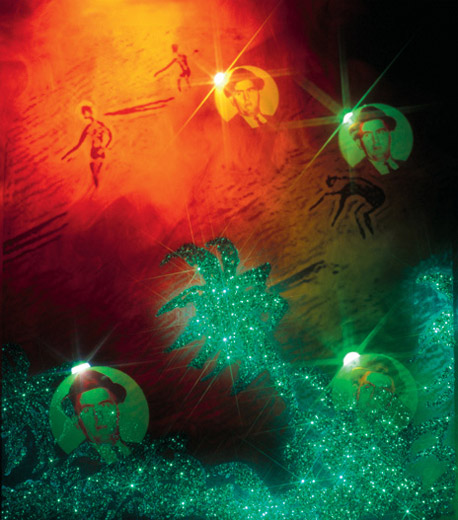
Surfers and Tony) The historical source image incorporated in this artwork features Police Officer Tony Murphy who had been closely associated with Terry Lewis, and was known as a key player in the 'Rat Pack' along with Glen Hallahan. Murphy was born in Brisbane in 1927, joined the police force at 21, moving up to CIB in early 50s and to the Licensing Branch 1966-71. Prostitute Shirley Brifman's accounts of Murphy's perjury in the National Hotel Royal Commission (1963-4) in 1971 led to charges being laid by (noncorrupt) Police Commissioner Whitrod's Crime Intelligence Unit in 1972. The National Hotel Royal Commission headed by Queensland Supreme Court Judge, Harry Gibbs was established to investigate allegations of police after-hours drinking and condoning of a call girl service at the National Hotel. Murphy's perjury charges were dismissed after Brifman's supposed suicidal overdose of sleeping pills 3 weeks prior to her giving evidence. Off the hook, Murphy took up a post in Toowoomba CIB 1973-6 and was ousted by Whitrod to Longreach in 1976 before Lewis, when newly appointed as Police Commissioner in Whitrod's place, bought him back to Brisbane to head the Crime Intelligence Unit in February 1977. Murphy's career in the police force went from strength to strength: Superintendent 1977, Queen's Police Medal 1978, Superintendent Far North Region 1980, and retired at 55 as Assistant Commissioner (Crime) in 1982. Whilst Murphy had been scrutinized in internal police investigations, appeared at the National Hotel Royal Commission (1964), Williams Royal Commission on Drugs (1980) and at the Fitzgerald Inquiry (1988) and was charged with many allegations in between, he was never sentenced. He was appointed TAB agent at Dunwich Stradbroke Island in 1983 allegedly on the insistence of the then TAB Chairman Sir Edward Lyons. He is believed to be growing orchids on Stradbroke Island. |
(reference:
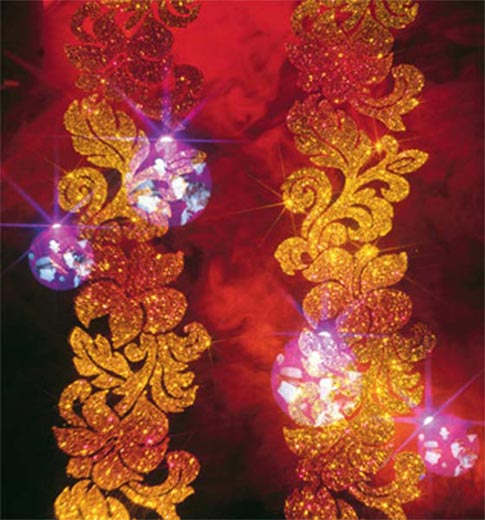
Gold Hibiscus and Special Branch) The historical image incorporated in this artwork is one of the first street demonstrations held in Brisbane on the 22nd March 1966, outside the US Consul's office in Queen St Brisbane. 200 people gathered peacefully to protest US involvement in the Vietnam War. The image features Special Branch chief Leo De Lange talking to Queensland University student activist Brian Laver at U.S. Consul's office whilst Detectives Dave Ferguson, Ross Beer, Al Higgs and Don Lane look on. Ross Beer denied allegations made in parliament in 1983 that he frequented Valley casinos and in April 1987 was made head of the Gaming Squad. He was later named in the Fitzgerald Inquiry as being a part of 'The Joke'. |

Cibachrome
Photographs
Cibachrome prints are an archival quality photographic print noted for depth and
richness of colour. Cibachrome prints are a rare and exclusive photographic medium
used now only in artistic contexts. High quality accurate dyes are coated into
the layers of the print surface. Through a dye-bleach process areas are removed
from the print layers leaving a luminescent depth of colour unmatched in other
photographic print processes. The cibachrome prints are then mounted onto an archival
thin aluminium surface on board to create a mirror finish. The image is suspended
in a black wooden frame between the backing board and the perspex front. This
creates a safe environment for the artwork and creates the illusion of the image
floating in space.
Photographic Process
While Jay Younger's earlier photographic artworks are made by montaging film pieces
together, the current Ulterior series is made through an equally elaborate in-camera
montage process. The in-camera montage used for Ulterior is made up from three
separate set-ups that are photographed over the top of each other on the same
piece of film to produce the resulting image. The image is composed from overlaying
sparkling tropical patterns, historical source images, and smoke. Each component
requires different techniques including 'painting with light', projection onto
smoke, creating sparkles and capturing slowed movement. The movement of smoke
would normally be photographed with daylight balanced flash to freeze movement,
however 'painting with light' requires long exposures, and the use of projection
requires tungsten balanced film.
These technical requirements are conflicting. As each glitter pattern may require
to be painted with a number of different coloured lights and the historical image
may be photographed over and over from different angles and distances, the image
usually takes about 25 minutes and may be made from 9 exposures or so. While the
moving smoke is a single exposure, the movement of smoke in particular is open
to chance. Many smoke bursts aren't photographed as the smoke may blow in another
direction, or may be too thick or too thin. As the photographer is not photographing
an existing scene, the in-camera montage is shooting 'blind' especially with the
elements of moving smoke and sparkles. A high shooting ratio is necessary as the
in-camera compositions are more random and final images where the three separate
set-ups cohere are rare. From 30 or 40 images taken on is printed.
 |
|
 |