



|
|
|
|
|
|
After the commencement of the Afghanistan war, I was not sure whether I should be more disturbed by the war itself, or the abundance of cheap war toys which seemed to flood the market at that time. My response was to collect them over a period now spanning 4 years. Gradually they formed the basis for this work, the darker side of which ponders the ways in which popular culture and media have been used to make the case for a conflict which is relatively unsupported outside fundamentally conservative communities (of all religious persuasions). Yet despite its black humor, it is my hope that the work is not heavy handed or angry.
The lenticular medium also plays an important part in the visual language employed by this work. The medium is popularly used to create engaging images for children. Here its fun, frivolous and toy-like nature, and a comics aesthetic, is subverted to reveal how even the most unlikely stories can make their way into popular culture and into the realm of 'truth', principally through media associated with entertainment.
The artworks are large scale lenticulars, which animate as a viewer walks by - the largest being 75 cm x 75 cm. These are much larger than the ones you may be accustomed to, but if you want a small lenticular from the series, you can buy one from the site as a limited number of small ones have been made. They vary in size but the largest is 10 x 10 cm.
Priscilla Bracks' Making the Empire Cross abounds with comic book convention in an attempt to reveal the "truth" behind news and how this connects with entertainment. Using lenticular photography, lush, glossy and colourful, Bracks exploits our fascination with the faux third dimension and perhaps childhood memories of playing with lenticular rulers and kitsch religious post cards. She then presents her work on a simulated movie website with all the trappings including the making of, characters, a narrative, behind the scenes, stars and gossip. Based on current news footage the characters are recognisable and audiences are instantly familiar with both them and their story, be it truth or fiction.
David Broker
 |
 |
 |
 |
 |
What is a Lenticular Image
A lenticular image allows the viewer to see different images on a single picture surface, when it is viewed from different angles. Whilst the name lenticular image may be unfamiliar, most people will have seen lenticular images before. For example, they are commonly used to create moving images on tazos or collector cards, and distributed as gimmicks in packets of potato crisps.
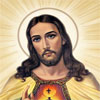
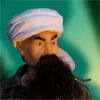
This changing image effect can be used to create an illusion of movement (see for example Meanwhile, Back at the Ranch), or it can be used to change the image between two entirely different images (eg GI Joe v Jihad Joe).
A lenticular image has two components:
• a printed image created by interlacing a number of different image
frames together; and
• a lenticular lens screen through which the image is viewed.
The first step in making a lenticular image is to produce each frame of the image. A lenticular image can contain many frames (some say up to 70). The images in Making the Empire Cross – Unleashed! have two frames each.
The frames were created using Adobe Photoshop. A specialised software program
was then used to interlace the two frames together. This means that the two
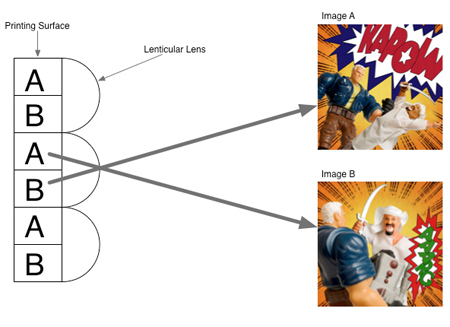
frames (Image A and Image B) were divided into hundreds of thin strips and recombined
in the manner shown in Figure 1. For this series a print of the interlaced image
was then made using archival pigment inks.
This print does not look at all like either of the two component images, although
fragments of the images do make them recognizable. The images become visible
once a lenticular lens has been carefully aligned over the interlaced image.
Once the lens is in place, the viewer can only see one frame at a time. This
is because the ribbed lenticular lens has a series of parallel lenses (lenticules)
on its surface that magnify portions of the segmented (interlaced) image underneath.
The wikipedia also has a good description of lenticular
images and http://www.lenstar.org also
provides information on creating lenticular images.